
Are AI Medical Subscriptions Worth It? The 2026 Guide for Doctors and Clinics
Artificial intelligence in medicine is no longer purchased only as a major hospital project. It now arrives as a monthly charge on a physician’s credit card, a per-clinician line in a clinic budget or a negotiated platform contract covering an entire health system. The most visible category is the AI medical scribe subscription: software that listens during a consultation, converts speech into a transcript and drafts a structured clinical note for the clinician to review. But the subscription model is also spreading into medical coding, prior authorization, patient messaging, radiology workflow, clinical decision support and revenue-cycle management. That shift matters because a subscription does more than replace typing. It can alter how clinicians divide their attention, when charts are closed, which data flow outside the electronic health record and how a practice calculates the value of an appointment.
Price is the easiest number to compare and often the least complete. A $59 plan that cannot push a note into the practice’s EHR may cost more in manual transfer time than a $119 plan with a dependable integration. A free AI scribe can be an excellent way to test note quality, yet its eligibility, data-retention choices, administrative controls or support model may not fit a multi-site clinic. The economically useful comparison is not simply “free versus paid.” It is the total cost per completed, clinician-approved note, including subscription fees, onboarding, integration, review time, corrections, support work, privacy assessment and any workflow failure that pushes documentation back into the evening.
This guide evaluates subscriptions as medical infrastructure rather than novelty software. It asks whether the product reduces the work that contributes to burnout or merely moves it from typing to editing. It examines whether the software improves patient interaction without creating unacceptable privacy friction, whether its EHR connection works with the practice’s exact configuration and whether its return can be measured without pretending that every saved minute becomes a billable visit. Medicine is a high-consequence environment: a fluent note can still be wrong, a suggested code can still be unsupported and a security badge does not replace due diligence.

How AI subscriptions are changing the medical encounter
An ambient scribe changes the sequence of documentation. In a conventional visit, the clinician may type while the patient speaks, enter brief fragments for later expansion or rely on memory when finishing the note. An ambient system captures the conversation, identifies clinically relevant statements and proposes sections such as the history of present illness, assessment and plan. The clinician remains responsible for reviewing, correcting and signing the record. That review is the safety boundary between automated drafting and the legal medical chart. In a 2026 prospective study of 169 consultations, ambient-scribe use was associated with 15% less documentation time and 10.6% more eye-contact time, while total patient-cycle time did not change significantly. This suggests that some of the saved effort was redirected toward the patient instead of faster turnover. (JMIR Medical Informatics)
The effect now extends beyond transcription. More expensive plans increasingly combine note creation with templates, visit preparation, patient instructions, referral letters, coding suggestions and browser-based EHR transfer. This can turn ambient clinical documentation software into a workflow layer around the electronic record—but it can also create subscription creep. A clinic might begin with an inexpensive scribe, add a coding module and later pay for integration, analytics and team administration. Each feature should therefore be tied to a defined job. “AI assistant” is vague; “draft the SOAP note, produce patient instructions and transfer both into the correct EHR fields for approval” is measurable.
Subscriptions also shape behavior through their pricing models. Per-seat pricing encourages organizations to concentrate licenses among heavy users. Per-note pricing can discourage use for short visits. Unlimited plans encourage experimentation but can increase the amount of generated text that clinicians must review. Enterprise integrations may achieve better adoption because they eliminate clicks, yet they can deepen vendor dependence and increase switching costs. A free product is not free to govern: the clinic still needs policies covering consent, recording, retention, errors, approved devices and service outages.
AI medical scribe pricing comparison
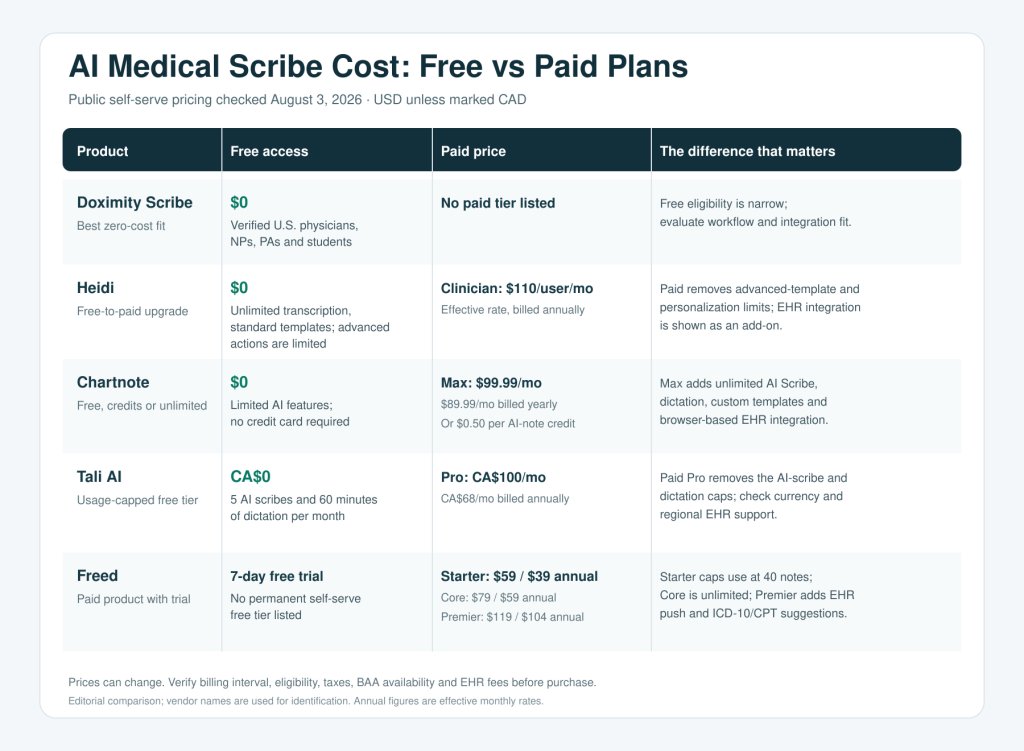
Starting prices often conceal the real buying decision. Doximity is free for eligible verified U.S. clinicians, Heidi provides unlimited transcription with limited advanced features, Freed offers tiered plans, Chartnote combines ambient scribing with EHR tools, and Abridge uses enterprise sales pricing.
Free plans are best for testing accent recognition, specialty terminology, note quality, privacy, and editing time across realistic encounters. The key question is not which tool is cheapest, but which affordable plan meets clinical and integration requirements.
Paid tiers are justified when unlimited notes, EHR integration, shared templates, or analytics save measurable time. Buyers should also verify whether training, implementation, storage, support, interfaces, and termination assistance cost extra.
How to calculate AI scribe ROI honestly
A defensible AI scribe ROI calculation begins with time rather than optimistic revenue. Measure baseline documentation minutes during visits, between visits and after hours. During the pilot, repeat the measurement and include review and correction time. Monthly net hours saved can be calculated as:
(baseline documentation minutes − AI-assisted documentation and review minutes) × eligible monthly visits ÷ 60
Those hours should then be assigned a value that reflects what the practice will actually do with them. Time used to go home earlier has real well-being and retention value, but it should not be recorded as immediate revenue. Time used for additional appointments can create revenue only if demand, rooms, support staff, scheduling and payer conditions allow those visits to happen. Time that enables earlier chart closure has operational value even when volume remains unchanged. Subscription, integration, training, security and support costs should then be subtracted.
Consider a hypothetical physician completing 360 eligible visits monthly. If observation shows that the subscription saves three net minutes per encounter after correction time, the physician recovers 18 hours. With a $119 monthly plan and an internal time value of $75 per hour, the measured time value is $1,350. The simple benefit after the license is $1,231 before implementation and oversight expenses. But that is not automatically $1,231 in cash profit. If only four recovered hours create additional appointments while the remainder improves work-life balance, the financial and human benefits should be reported separately.
Emerging evidence suggests that financial productivity can change, but causal claims require care. A 2026 cohort study covering more than 1.2 million included ambulatory encounters found that AI-scribe adoption was associated with 0.04 more relative value units per encounter, 1.81 more RVUs per physician-week and 0.80 additional encounters weekly. It found no difference in the share of denied claims. Because clinicians voluntarily adopted the tools, those associations should not become guaranteed revenue promises. A practice should test its own specialty, payer mix, documentation baseline and capacity constraints. (JAMA Network Open)

What clinical research says—and does not prove
The clinical evidence is encouraging but heterogeneous. A 2025 outpatient quality-improvement study involving 46 clinicians from 17 specialties reported 20.4% less note time per appointment, greater same-day closure and 30% less after-hours work. Another 2025 study reported 74% lower odds of burnout after 30 days with one ambient platform, but translated the time benefit to approximately 10.8 minutes per workday. The 2026 Singapore study found a 0.8-minute reduction in documentation per consultation and better eye contact without a significant reduction in total cycle time. These results can coexist: reduced cognitive load and better presence may feel transformative even when measured clock-time savings are modest. (JAMA outpatient study, JAMA burnout study)
Efficiency does not eliminate clinical verification. Ambient systems can omit a qualification, attribute a statement to the wrong speaker, convert uncertainty into certainty or introduce a plausible detail that nobody said. Longer notes are not automatically better notes. A safe process identifies the output as a draft and requires review of medications, allergies, diagnoses, laterality, numerical results, examination findings, assessment, plan and follow-up before signature. Correction time should be measured during procurement because a product that produces polished but unreliable notes may perform worse than a simpler tool.
Privacy and security are part of the product’s clinical effect because trust affects what patients and clinicians will say. In the United States, a vendor handling protected health information for a covered entity may be a business associate. HHS says written assurances must define permitted uses and require suitable safeguards. A clinic evaluating HIPAA-compliant AI software for healthcare should therefore examine the business associate agreement, audio retention, transcript deletion, encryption, access controls, audit logs, subprocessors, incident notification, model-training policy, export and termination—not merely accept a “HIPAA compliant” label. (HHS business-associate guidance)
The best AI medical scribe depends on the specialty
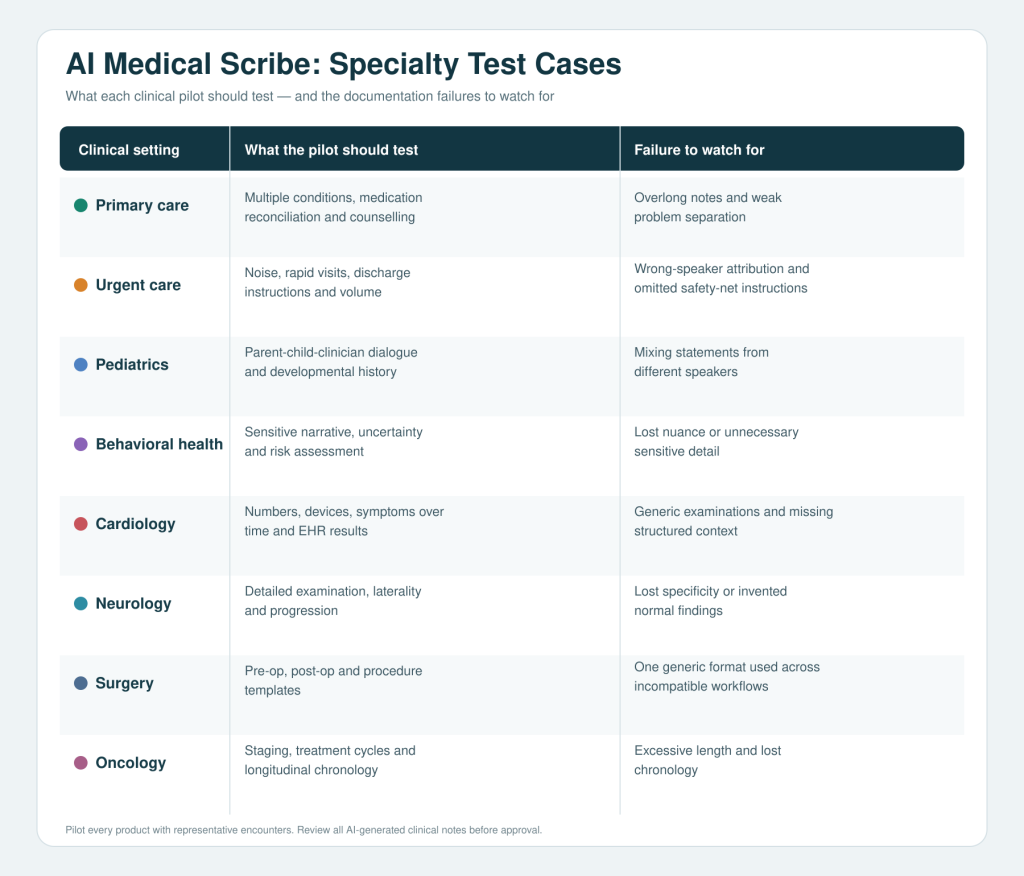
There is no universal best AI medical scribe because documentation needs vary by specialty. Primary care requires multi-problem histories and counselling, while urgent care prioritizes speed. Surgeons need procedure-specific terminology, and cardiology or neurology often requires structured examinations and EHR context. A tool that produces excellent family-medicine SOAP notes may still generate inadequate specialist documentation.
A 2026 review reported improved work experience among 85% of a small primary-care group, compared with 36.4% in medical subspecialties and 50% in surgical subspecialties. Although these results do not rank products, they emphasize the importance of specialty customization.
Primary care, urgent care and telehealth are strong starting points for ambient documentation. Buyers should test problem separation, clinical reasoning, background noise, discharge instructions and connection interruptions. Pediatric practices must also evaluate whether the software correctly distinguishes between the child, caregiver and clinician.
Specialists require tougher testing. Cardiologists and neurologists should assess temporal details, laterality and quantitative findings. Surgeons should test pre-operative, post-operative and procedure notes, while oncology and behavioral-health teams must evaluate longitudinal histories, sensitive disclosures and clinical nuance.
Recent studies found differences in documentation content and only moderate note quality in challenging cross-specialty simulations. Therefore, clinicians should test each subscription using their specialty’s most difficult common encounters—not its easiest demonstrations.
Specialty-specific test cases
Patient consent should be a conversation
Patient consent is both a legal and trust question. Requirements vary by jurisdiction, recording method, organization and data use. A sensible minimum is to inform the patient before capture begins, explain what the software does, identify whether audio is retained, state that the clinician will review the draft and make refusal easy. The visit should continue normally when a patient declines.
Organizations should decide whether consent is verbal or written, how it is documented, whether it must be renewed at every encounter and how telehealth and interpreted visits are handled. They should obtain jurisdiction-specific advice rather than copying a generic online form.
A plain-language script could be:
“I use a secure documentation assistant that listens during our conversation and prepares a draft note for me to review. You can say no, and it will not affect your care. Is it okay if I turn it on?”
The wording must accurately reflect what the product and contract actually do.
Patients are not uniformly opposed to ambient technology. A 2026 Stanford Health Care study surveyed 2,202 people who had experienced an ambient scribe: 70.1% found it helpful and 73.6% preferred its use in future visits, although researchers observed small differences across demographic groups. An AMA report described a health system that requested consent at every encounter and reported 95% acceptance. These findings support transparent implementation—not silent recording. (JAMIA Open, American Medical Association)
Equity requires more than translating the consent script. Speech recognition can perform differently across accents, languages, speech impairments and noisy environments. A note generator can reproduce patterns in its training data. Clinics with limited connectivity or smaller budgets may receive a lower-quality version of the technology than large health systems. Professional interpreters should remain active participants instead of being replaced by an unvalidated transcription feature.
The clinic should stratify note quality, omissions, correction time, consent and adoption by language and other relevant groups while protecting privacy. WHO’s generative-AI guidance warns that these systems can produce false, inaccurate, biased or incomplete information. A 2026 WHO/Europe review also reported that equity and fairness checks are still not standard across many digital-health implementations. (WHO generative-AI guidance, WHO digital-health equity review)
Will AI medical subscriptions replace healthcare jobs?
For current documentation products, task redistribution is a more accurate description than simple job replacement. AI scribes automate parts of capture, organization and drafting, but clinicians still provide judgment, correct mistakes and approve the final record. Medical assistants may spend less time pursuing incomplete documentation and more time preparing visits, coordinating follow-up or managing exceptions.
Human scribes may move toward complicated encounters, quality assurance, implementation support and exception handling, although demand for purely transcription-based roles could decline. Coders and billing staff may receive suggestions earlier, but they still need to verify that documentation supports the selected codes and that payer requirements are satisfied. An AI product that creates verbose or inconsistent notes can increase downstream review rather than reduce it.
Organizations should therefore measure:
- Which tasks disappear completely?
- Which tasks become shorter?
- Which tasks move to another employee?
- Which new review and governance tasks appear?
- Which tasks remain too complex or sensitive to automate safely?
The safest redesign includes staff who understand the actual workflow. Medical assistants know which templates fail and where official processes differ from reality. Nurses can identify omitted teaching or follow-up. Coders can determine whether documentation genuinely supports a suggested service. Front-desk staff can help design patient explanations and refusal pathways. Privacy, security and IT teams can evaluate access, retention, outages and incident response.
These employees are not barriers to automation. They hold operational knowledge that a vendor demonstration does not contain. Excluding them can produce a technically successful deployment that quietly increases work elsewhere. Including them helps reveal the subscription’s true cost.
New responsibilities also need explicit ownership. Someone must maintain the authorized-product list, monitor incidents, communicate model changes, update templates and decide when a feature should be paused. Large systems may establish an AI governance committee; a small practice can allocate the same functions to named individuals.
The governance structure should answer:
- Who owns clinical quality?
- Who owns privacy and security?
- Who manages the vendor and contract?
- Who can suspend the product when risk exceeds benefit?
This structure aligns with the NIST AI Risk Management Framework’s four functions: Govern, Map, Measure and Manage. (NIST AI Risk Management Framework)

A buyer’s scorecard for AI healthcare software
Procurement should begin with a measurable use case. “We want AI” is not a use case. “We want family-medicine clinicians to reduce median after-hours note time without increasing material documentation errors or patient complaints” is measurable.
AHRQ recommends requesting clinical validation information, known failure modes, population limitations, data transparency, model-update policies, integration requirements and evidence concerning equity, safety and clinical decisions. The practice should establish weights before vendor demonstrations so that charisma and brand recognition do not control the result. (AHRQ healthcare-AI guidance)
Weighted vendor evaluation matrix
| Category | Weight | Evidence to request |
|---|---|---|
| Clinical note quality and correction burden | 25 | Blinded review, error taxonomy, specialty validation and edit time |
| Workflow and EHR integration | 20 | Live test, supported fields, downtime process and export |
| Privacy, security and governance | 20 | Contract, retention, deletion, encryption, audit logs and incident terms |
| Economics and flexibility | 15 | Annual cost, implementation, support, price increases and termination |
| Equity, language and accessibility | 10 | Subgroup testing, languages, interpreter workflow and accessibility |
| Support and vendor reliability | 10 | Service levels, onboarding, escalation, uptime and references |
| Total | 100 | Score only after supporting evidence is reviewed |
Clinical quality receives the greatest weight because inexpensive software that requires heavy correction is not a bargain. Workflow and EHR integration come next because manual transfer erodes the subscription’s value. Privacy and security must be scored from evidence and contracts rather than badges. Economics should include implementation and exit costs, not only the advertised fee.
Some requirements should be gates instead of points. If the clinic requires a business associate agreement, a particular hosting location, data export or support for a certain language, failure should disqualify the product regardless of its total score.
Contract review deserves a separate meeting. Confirm whether the organization owns and can export notes, templates and audit history. Determine whether the vendor may use identifiable or de-identified data to improve models, how deletion is verified, which subprocessors receive information and how quickly incidents must be reported.
The agreement should also address:
- Model and feature changes
- Uptime and maintenance
- Support response times
- Safe downtime procedures
- Integration and training fees
- Minimum seat commitments
- Renewal price increases
- Removal of unused seats
- Data return at termination
- Marketing use of the clinic’s name
- Right to suspend risky features
Important representations should appear in the contract or service schedule—not only in emails or presentations.
Twenty questions to ask a medical AI vendor
- Which exact clinical use is the product intended to support?
- Which specialties and visit types were independently evaluated?
- What errors occur most often?
- Can outputs be traced to the underlying conversation?
- What happens when speakers overlap?
- How are interpreters handled?
- Which languages and accents were tested?
- Does the EHR integration populate fields or merely paste text?
- What happens when the EHR or browser is updated?
- Is audio retained, and for how long?
- Are transcripts stored separately from finalized notes?
- Is customer data used for model development?
- Which subprocessors receive data?
- What audit and administrator tools are included?
- What is the security-incident notification period?
- How are model changes communicated?
- Can an individual feature be disabled?
- What can be exported when the contract ends?
- Which fees are excluded from the advertised subscription?
- Will the vendor place every important answer in writing?
A practical 30-day AI medical scribe pilot
A pilot should be narrow enough to control but broad enough to expose real failure.
Days 1–5: Establish the baseline
- Define the documentation problem.
- Measure note time, after-hours work and chart closure.
- Select clinicians with different documentation styles.
- Choose common and difficult encounter types.
- Approve privacy, consent and downtime procedures.
- Define material-error and correction-time thresholds.
Days 6–15: Begin limited use
Start with a controlled number of encounters. Review drafts for:
- Material errors
- Omissions
- Wrong-speaker attribution
- Unsupported findings
- Incorrect medications or diagnoses
- Wrong laterality or numerical values
- Excessive length
- Missing follow-up instructions
Hold short feedback sessions while experiences are recent. Avoid customizing the system entirely around one physician.
Days 16–25: Expand carefully
Increase volume only if the initial safety threshold is satisfied. Test more difficult encounters, EHR transfer, support response, languages and interpreter-assisted visits. Track whether work is quietly moving from physicians to nurses, assistants or coders.
Days 26–30: Calculate outcomes
| Measure | Baseline | Pilot result | Decision rule |
|---|---|---|---|
| Median note time | Pre-pilot measurement | Include review time | Must meet local improvement target |
| After-hours EHR work | Comparable clinic days | Comparable pilot days | Improve without shifting work |
| Same-day closure | Baseline percentage | Pilot percentage | Improve or remain stable |
| Material-error rate | Baseline sample if available | Blinded review sample | Stay below safety ceiling |
| Correction time | Not applicable | Minutes per note | Must not erase time savings |
| Patient acceptance | Not applicable | Rate by relevant group | Investigate uneven refusal |
| Clinician adoption | Not applicable | Eligible visits using tool | Analyze reasons for non-use |
| Staff burden | Baseline task log | Repeat during pilot | No hidden workload increase |
| Cost per approved note | Existing process | Total cost ÷ approved notes | Compare with alternatives |
The decision should not depend on one average. Software may save substantial time for some clinicians while creating additional work for others. Segment results by clinician, specialty, visit type, language and integration path where privacy and sample size permit.
A conditional approval may be appropriate: deploy only to clinicians who benefit, improve particular templates, require a contract revision and repeat interpreter testing. A rejection does not prove that medical AI is useless. It means that this product or configuration did not meet the organization’s threshold.
Monitoring must continue after purchase. Model updates, EHR changes and user behavior can change both benefit and risk. A subscription should earn renewal through evidence rather than inertia.
The larger effect on medicine will depend on what organizations do with the time recovered. If every saved minute becomes a higher productivity target, clinicians may experience automation as another demand. If some of the value returns as better attention, safer follow-up, earlier chart closure and less after-hours work, the subscription can support the human side of care.
Frequently asked questions
| Question | Answer |
|---|---|
| How much does an AI medical scribe cost? | Public individual plans in Part 1 ranged from free to approximately $119 per clinician monthly. Enterprise agreements generally require a quote. |
| Is a free AI scribe safe for patient information? | Price does not determine safety. Verify the account, contract, retention, permitted use and security controls. |
| Does an AI scribe replace physician responsibility? | No. The clinician remains responsible for reviewing and approving the record. |
| Do patients need to consent? | Requirements vary. Patients should be informed before capture and refusal should not affect care. Obtain local legal guidance. |
| Can AI automatically select billing codes? | Some products suggest codes, but the service and documentation must support the final selection. |
| Which product has the best EHR integration? | The answer depends on the exact EHR and workflow. Require a live integration test. |
| Can a scribe create capacity for more appointments? | Sometimes. Demand, staffing, rooms, scheduling and payer conditions determine whether saved time becomes capacity. |
| How long should a pilot last? | Thirty days can reveal initial value and common failures. Complex health-system deployments may require longer evaluation. |
| What is the best purchase metric? | Total cost per safe, clinician-approved note is more informative than subscription price alone. |
| Will AI replace human scribes? | Some transcription work may decline, while quality assurance, complex documentation and exception handling may remain or grow. |